
Understanding True American Bully Type
The American Bully breed has a wide range of styles. Some dogs display more “classic lean” traits, while others carry heavier “extreme” features. Understanding the difference helps explain why breeders often combine both styles in breeding programs.
The image below illustrates a sample of the Pocket Bully class. The same male body-type variations apply across all American Bully classes.
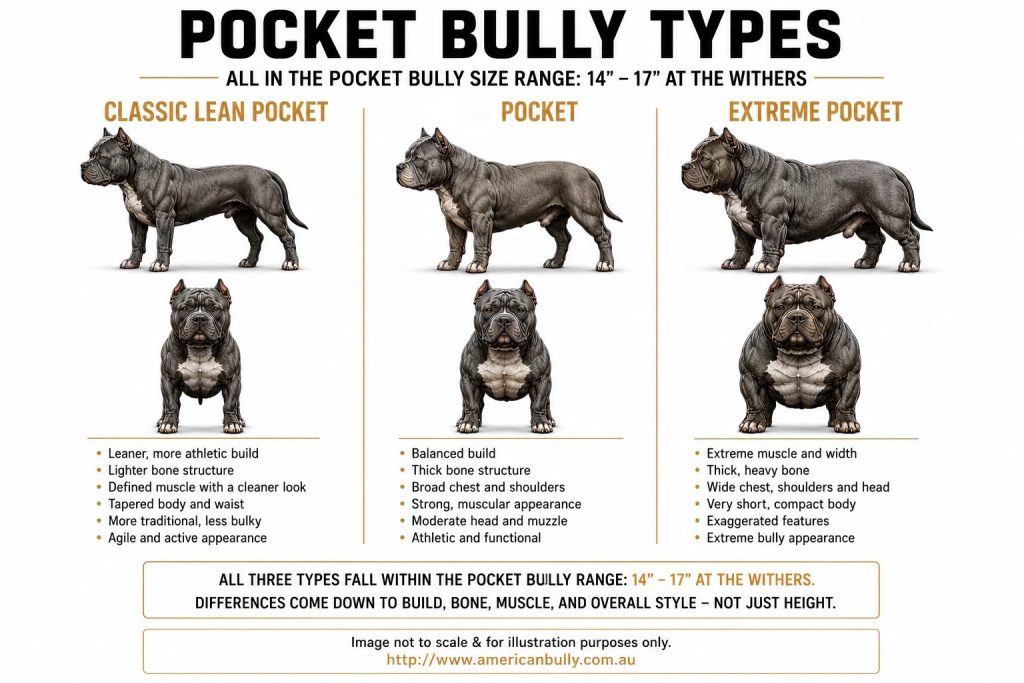
American Bully Extreme Features vs Lean/Classic Features
Lean / Classic Features
Lean or classic-type Bullies usually show:
- More athletic and functional movement
- Lighter bone and less overall mass
- Longer muzzle and cleaner facial structure
- More visible tuck-up and waist definition
- Higher resemblance to older APBT/terrier influence
- Moderate chest, shoulders and head size
These dogs are often described as:
- Cleaner
- Sportier
- More agile
- More moderate in appearance
However, “lean” does not automatically mean:
- structurally correct,
- healthy,
- or temperament sound.
A lean dog can still have:
- weak fronts,
- poor rear angulation,
- bad movement,
- breathing issues,
- unstable nerves,
- lack bully presence
- or incorrect temperament.
Structure, health and temperament depend on genetics, selection and breeding decisions — not simply body size.
Extreme Features
Extreme-style Bullies are bred for:
- More muscle mass
- Heavier bone density
- Larger head size
- Wider chest and shoulders
- Shorter compact body
- More substance and “bully presence”
- Thick neck and exaggerated features
The goal is often a dog with:
- powerful appearance,
- heavy mass,
- and strong visual impact while still maintaining functional movement and stability.
Why Lean Dogs Often Need Extreme Blood
Many lean/classic dogs lack:
- enough bone,
- head size,
- chest width,
- or overall substance.
Because of this, breeders often introduce extreme bloodlines to:
- increase mass,
- improve head type,
- add width,
- and create more bully expression.
Without stronger mass genetics, offspring from two lean dogs commonly remain:
- lighter framed,
- more terrier influenced,
- and less “bully” in appearance.
Producing True Extreme Offspring Is Rare
Producing genuine extreme offspring consistently is difficult because genetics naturally pull many puppies back toward moderate or lean traits.
Even when using one extreme parent:
- many pups still mature closer to classic/lean structure,
- lighter bone,
- or terrier-style proportions.
This is why truly balanced extreme dogs are uncommon.
A breeder may produce:
- only one or two standout extreme pups (sometime neither) in an entire litter,
- while the rest mature more moderate.
Extreme traits are not guaranteed simply by breeding two heavy dogs together. Correct structure, health, movement and temperament still need to be maintained alongside mass.
Balanced Goal
The ideal goal for many breeders is not simply:
- “lean” or “extreme,”
but rather:
- a balanced American Bully with:
- correct structure,
- sound movement,
- stable temperament,
- good health,
- and strong bully breed type.
The challenge is achieving:
- mass without dysfunction,
- compactness without restriction,
- and bully presence without sacrificing athletic ability.
What is Bully Presence
“Lack bully presence” refers to a dog that does not visually project the strong, powerful, unmistakable American Bully look.
This usually means the dog appears:
- too narrow,
- too light framed,
- too terrier-like,
- or lacking substance and impact.
Common signs of lacking bully presence include:
- Narrow chest
- Light bone structure
- Small or narrow head
- Thin neck
- Flat muscle development
- Longer lean body with little mass
- Minimal width through shoulders and rear
- Terrier-style appearance overpowering bully traits
Strong Bully Presence
Dogs with strong bully presence typically show:
- Wide powerful stance
- Thick bone and muscle
- Broad chest and shoulders
- Large blocky head
- Thick neck connection
- Compact balanced proportions
- Confidence and stable temperament
- Strong overall visual impact
Bully presence is not only about size. A dog can be:
- leaner,
- athletic,
- and still have bully presence if structure, proportions and breed type are correct.
Important Point
Extreme mass alone does not equal bully presence.
A dog can be:
- overweight,
- overdone,
- poorly structured,
- or exaggerated,
and still lack true bully presence if balance and breed type are missing.
True bully presence comes from the combination of:
- structure,
- proportion,
- muscle,
- head type,
- movement,
- confidence,
- and overall balance.
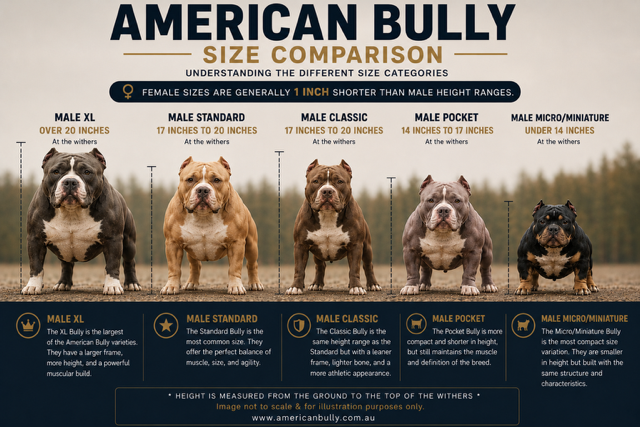
American Bully size comparison learn more: Click Here
For more breed education, structure discussions, and American Bully resources, visit: