
Understanding Bloodline Influence in American Bullies
Understanding Bloodline Influence
Bloodline influence is one of the most important concepts in American Bully breeding. Every dog carries generations of genetics that shape its structure, temperament, health, and overall breed type. Understanding how bloodlines work allows breeders to make informed decisions that improve consistency while preserving the characteristics that define the American Bully.
A pedigree is more than a list of names. It represents generations of genetic strengths, weaknesses, and breeding decisions that influence every puppy produced. The ability to recognize and utilize these influences is what separates successful breeding programs from those that simply produce litters.
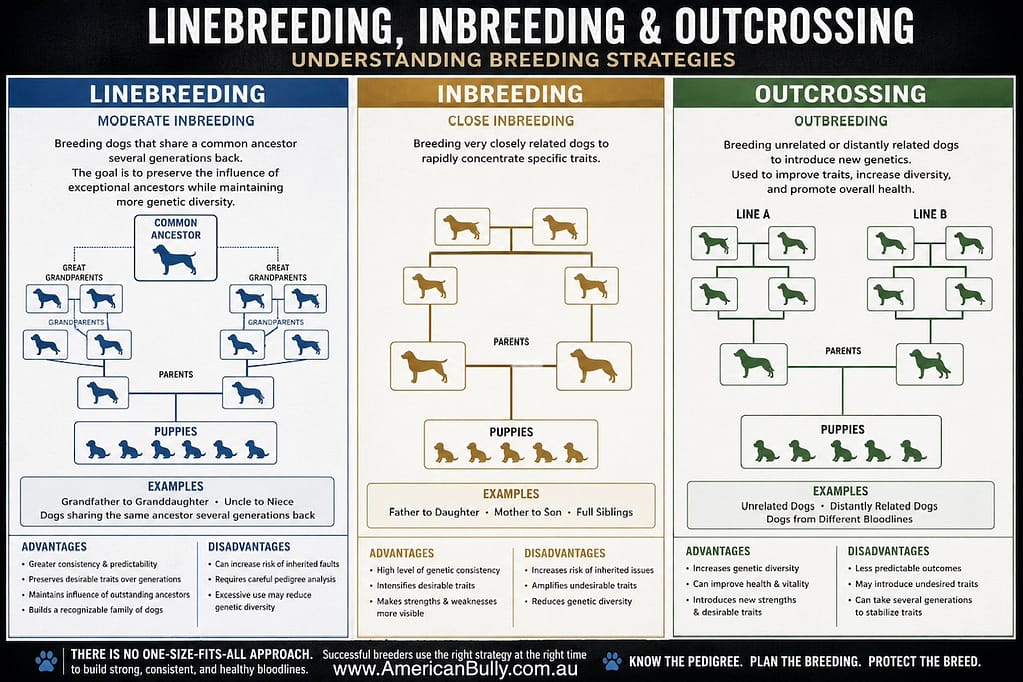
Inbreeding, Linebreeding and Outcrossing
Breeders use different breeding strategies to achieve specific goals. The three most common methods are inbreeding, linebreeding, and outcrossing.
Inbreeding
Inbreeding involves breeding very closely related dogs, such as father to daughter, mother to son, or full siblings. The purpose is to rapidly concentrate specific traits within a bloodline.
Advantages:
- Creates a high level of genetic consistency.
- Intensifies desirable traits.
- Helps identify both strengths and weaknesses within a bloodline.
Disadvantages:
- Increases the risk of inherited health issues.
- Can amplify undesirable traits and genetic faults.
- Reduces genetic diversity.
While inbreeding can be an effective tool in experienced hands, it requires extensive pedigree knowledge, health testing, and careful evaluation of breeding stock.
Linebreeding
Linebreeding is a more moderate form of inbreeding and is often considered the preferred method for establishing and maintaining a recognizable bloodline. It involves breeding dogs that share common ancestors but are not closely related enough to be considered direct inbreeding.
Examples include:
- Grandfather to granddaughter
- Uncle to niece
- Half siblings (tight line-breeding)
- Dogs sharing the same influential ancestor several generations back
The goal of linebreeding is to preserve the influence of exceptional individuals while minimizing the risks associated with close inbreeding.
Advantages:
- Produces greater consistency and predictability.
- Maintains desirable traits over multiple generations.
- Preserves the influence of outstanding dogs within a pedigree.
- Allows breeders to build a recognizable family of dogs.
Disadvantages:
- Can still increase the likelihood of inherited faults if poor-quality dogs are used.
- Requires detailed pedigree analysis and long-term planning.
- Excessive linebreeding over multiple generations may reduce genetic diversity.
Many of the most successful American Bully bloodlines were developed through carefully planned linebreeding programs. When practiced responsibly, linebreeding helps breeders create dogs that consistently reproduce the characteristics that define their kennel and bloodline.
Outcrossing
Outcrossing involves breeding dogs that are unrelated or only distantly related. This introduces new genetics into a breeding program and is often used to improve specific traits or increase genetic diversity.
Advantages:
- Increases genetic diversity.
- Can improve overall health and vigor.
- Introduces new strengths and desirable traits.
Disadvantages:
- Less predictable outcomes.
- May introduce traits that do not align with breeding goals.
- Can require several generations to stabilize desired characteristics.
Outcrossing is often used strategically when breeders want to improve a particular trait, correct a weakness, or inject fresh genetics into an established bloodline.
Consistency and Predictability
One of the primary goals of any breeding program is producing consistent and predictable results.
Consistency means that puppies produced over multiple generations display similar qualities in:
- Structure
- Head type
- Bone density
- Movement
- Temperament
- Overall breed type
Predictability comes from understanding how traits are inherited and identifying dogs that consistently reproduce their best qualities. The more predictable a bloodline becomes, the easier it is for breeders to make informed breeding decisions.
Consistency is rarely achieved by chance. It is the result of careful selection, pedigree analysis, and generations of strategic breeding.
Genotype vs Phenotype
To understand bloodline influence, breeders must understand the difference between genotype and phenotype.
Genotype
Genotype refers to a dog’s genetic makeup—the genes it carries and can pass on to future generations.
These include:
- Structural genetics
- Color genetics
- Health-related genes
- Temperament traits
- Size and growth potential
Many genetic traits remain hidden and may not be visible in the dog itself.
Phenotype
Phenotype is the physical expression of those genes—the traits that can be seen and evaluated.
Examples include:
- Head shape
- Muscle development
- Body structure
- Coat color
- Movement and athleticism
An impressive phenotype does not always guarantee superior breeding potential. Likewise, some dogs may not be exceptional show dogs but consistently produce outstanding offspring because of the genetics they carry.
Successful breeders learn to evaluate both genotype and phenotype when selecting breeding stock.
Building a Strong Foundation
Every respected American Bully breeding program begins with a strong foundation.
Start with Quality Dogs
The foundation dogs determine the future direction of a breeding program. Selecting dogs with sound structure, stable temperament, and proven genetics is essential.
Prioritise Health
Health testing and genetic screening should always take priority over trends or appearance. Healthy dogs create healthier bloodlines.
Study Pedigrees
Understanding pedigrees helps breeders identify influential ancestors and recognize patterns that contribute to consistency.
Establish Clear Goals
Every breeding decision should support a long-term vision. Whether the goal is improved structure, movement, temperament, or breed type, consistency comes from breeding with purpose.
Be Patient
Strong bloodlines are built over generations, not overnight. The most respected breeders understand that success comes from patience, discipline, and continual evaluation.
Final Thoughts
Bloodline influence is the foundation of every successful American Bully breeding program. Understanding the differences between inbreeding, linebreeding, and outcrossing allows breeders to make educated decisions that balance consistency, predictability, and genetic diversity.
By understanding genotype and phenotype, studying pedigrees, and building from a strong foundation, breeders can develop bloodlines that consistently produce healthy, structurally sound, and breed-correct American Bullies for generations to come.
For more breed education, structure discussions, and American Bully resources, visit: