
Looking Beyond Faults: Recognising Quality in the Complete Dog
One of the most important skills a breeder can develop is the ability to evaluate a dog as a whole rather than becoming fixated on individual faults.
In today’s social media-driven world, it is common to see dogs criticised for a particular feature. While breed standards exist to guide breeders toward consistency and improvement, experienced breeders understand that evaluating dogs is rarely as simple as identifying faults.
The reality is that, No dog is perfect.
Every dog, regardless of pedigree, bloodline, or level of success, possesses both strengths and weaknesses. The role of a knowledgeable breeder is not to find perfection, but to recognise quality, understand balance, and make informed decisions that improve future generations.
Topic discussion
- The Difference Between Fault Finding and Dog Evaluation
- Why Perfect Dogs Do Not Exist
- Understanding the Importance of Strengths
- The Role of Breeding Decisions
- Looking Beyond Social Media Opinions
- Final Thoughts
The Difference Between Fault Finding and Dog Evaluation
Anyone can point out a fault.
True evaluation requires understanding how all the pieces fit together.
A dog may possess a minor fault while excelling in breed type, temperament, structure, movement, health, and overall contribution to the breed. Conversely, a dog may have very few obvious faults yet lack the qualities that define exceptional breed type or long-term breeding value.
Successful breeders look beyond isolated characteristics and assess the complete dog.
They ask questions such as:
- Does the dog represent the desired breed type?
- Does it possess sound structure and movement?
- Is the temperament stable and predictable?
- Does it consistently produce quality offspring?
- Does it improve the breeding program?
- Are its strengths significant enough to outweigh its weaknesses?
These questions provide far more valuable insight than simply identifying a list of imperfections.
Why Perfect Dogs Do Not Exist
Every breed standard describes an ideal.
However, the ideal dog exists more as a target than a reality.
Even the most influential dogs in breed history possessed faults. Many legendary producers, show champions, and foundation dogs were not flawless specimens. What made them valuable was the combination of strengths they brought to the breed and their ability to consistently pass those qualities to future generations.
If breeders eliminated every dog with a minor fault, genetic diversity would shrink dramatically and progress would become nearly impossible.
Breeding has always involved balancing strengths and weaknesses while working toward long-term improvement.
Understanding the Importance of Strengths
A common mistake among inexperienced breeders is placing too much emphasis on faults while overlooking exceptional qualities.
For example, a dog may have:
- Outstanding breed type
- Excellent temperament
- Sound movement
- Proven health history
- Strong genetic consistency
- Exceptional production ability
Yet some observers may focus solely on a single cosmetic fault.
Experienced breeders understand that the overall value of a dog cannot be judged by one characteristic alone.
The question is not whether faults exist.
The question is whether the dog’s strengths make it a valuable contributor to the breed despite those imperfections.
The Role of Breeding Decisions
A quality breeding program is built on strategic pairing rather than individual perfection.
Responsible breeders select mates that complement one another. One dog’s strengths may help offset another dog’s weaknesses, creating a more balanced outcome in future generations.
This approach has been used by successful breeders across all breeds for decades.
Rather than searching for mythical perfection, breeders focus on producing dogs that move closer to the breed standard over time while maintaining health, temperament, functionality, and breed identity.
Looking Beyond Social Media Opinions
Modern breeders face a unique challenge.
Social media often encourages quick judgments based on photographs, short videos, and personal preferences. While opinions are easy to share, meaningful evaluation requires far more information than a single image can provide.
Experienced breeders consider factors such as:
- Pedigree
- Production history
- Temperament
- Health testing
- Structure and movement
- Consistency across offspring
- Long-term breeding goals
These factors provide a far more accurate assessment of a dog’s true value than superficial criticism.
Final Thoughts
The most successful breeders understand that no dog is without faults.
Rather than dismissing an otherwise outstanding dog because of a few imperfections, they evaluate the complete package and recognise when exceptional qualities outweigh minor weaknesses.
Great breeding has never been about finding perfect dogs.
It is about identifying quality, understanding balance, and making thoughtful decisions that contribute to the long-term improvement of the breed.
The ability to see the whole dog—not just the faults—is what separates knowledgeable breeders from casual critics.

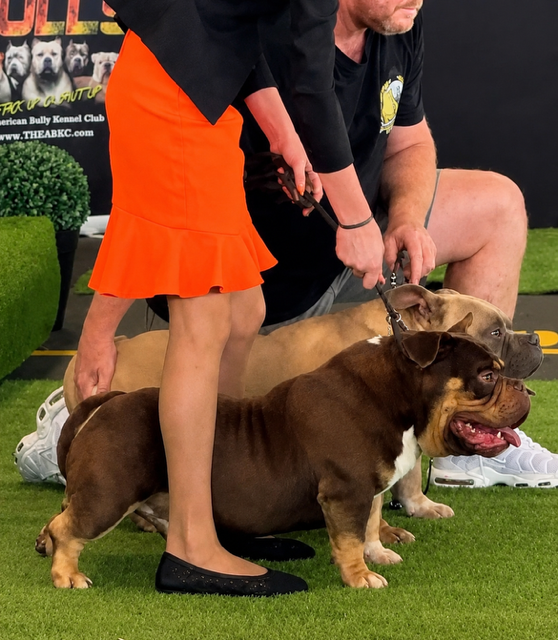
For more breed education, structure discussions, and American Bully resources, visit: