
American Bully Styles: American Bully vs Exotic Bully — Understanding the Difference
The American Bully has developed into one of the most visually diverse bully breeds, with dogs ranging from more traditionally proportioned, muscular American Bullies to extremely compact, heavily boned and Bulldog-influenced types.
Among these styles, the Exotic Bully has attracted considerable attention for its distinctive appearance.
While the two are closely connected, they are not simply two names for the same type of dog.
The Exotic Bully developed from the American Bully, with breeding programs placing greater emphasis on compactness, heavy bone, exaggerated features and increased Bulldog influence.
Today, some breeders also work toward what could be described as an Exotic-styled American Bully — a dog that incorporates selected Exotic characteristics while attempting to retain more balanced American Bully proportions and functionality.
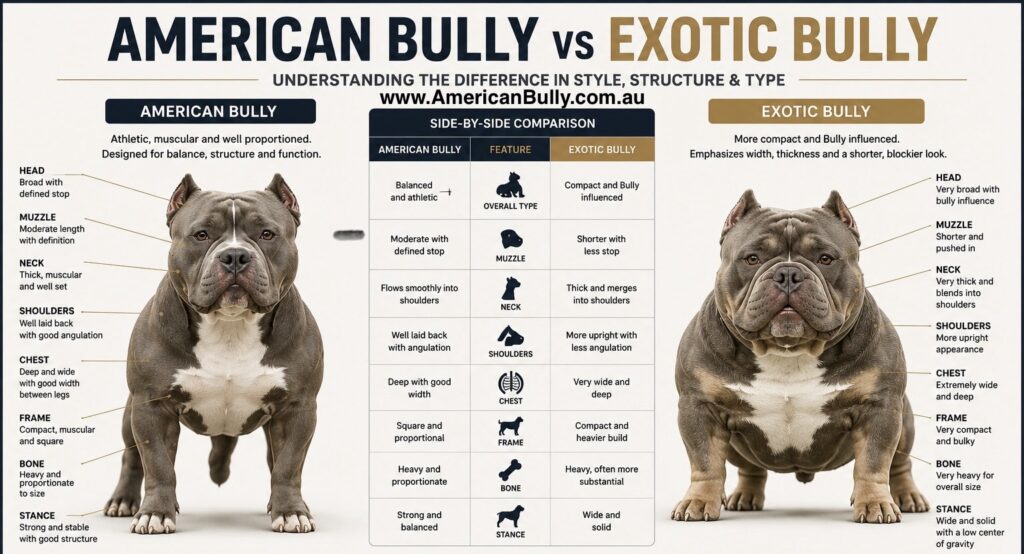
Understanding the difference requires looking beyond height or weight and examining the entire dog — including its proportions, head, bone, chest, muzzle, structure and overall type.
American Bully Styles and Variations
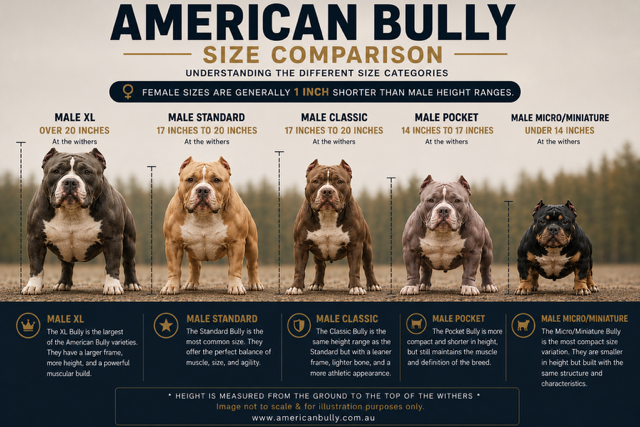
It is important to understand that terms such as Pocket, Miniature, Micro, Exotic, Extreme, Classic, Standard and XL are commonly used to describe different looks, sizes or styles of the American Bully, rather than automatically representing separate breeds. Want to understand how the different American Bully sizes compare?
Read our American Bully Breed Size Guide for a detailed breakdown of the different size categories, including height, proportions and key characteristics.
Different American Bully registries may recognise or classify these styles differently, and their standards can vary slightly. Regardless of the style, the American Bully is fundamentally recognised as a companion breed, known for its people-oriented temperament, muscular and substantial appearance, and the distinctive bulky, powerful “wow factor” that has become synonymous with the breed.
What Is the American Bully?
The American Bully was developed as a companion breed with an emphasis on a powerful, muscular and substantial appearance.
American Bullies are known for characteristics such as:
- A broad, blocky head
- Strong jaw and cheek structure
- Broad chest
- Heavy bone
- Thick neck
- Pronounced musculature
- Powerful rear assembly
- Compact, substantial body
- Confident but generally stable temperament
The breed has also developed into different size and style categories, meaning there can be significant variation between individual American Bullies.
A Pocket American Bully, for example, can look considerably shorter and more compact than a larger Standard or XL-type dog while still retaining the fundamental American Bully appearance.
This variation is important because “American Bully” does not describe one exact body shape.
What Is an Exotic Bully?
The Exotic Bully developed from the American Bully through selective breeding toward a shorter, more compact and increasingly Bulldog-influenced appearance.
The Exotic style generally places greater emphasis on exaggerated features such as:
- Very compact proportions
- Heavy bone
- Extremely broad chest
- Large, blocky head
- Shorter muzzle
- Shorter legs
- Thick neck
- Heavy muscle and substance
- Strong Bulldog-like facial characteristics
- A low-to-the-ground silhouette
The result is a dog that can look noticeably different from a more traditionally proportioned American Bully.
The Exotic is therefore not simply a smaller American Bully.
Its distinctive appearance comes from selecting for a different combination of proportions and characteristics, particularly those associated with stronger Bulldog influence.
The Bulldog Influence
One of the most important differences between the American Bully and Exotic type is the degree of Bulldog influence visible in the overall structure and appearance.
The American Bully itself was developed from multiple bully-type influences, and Bulldog characteristics are already present within the breed.
However, breeding toward the Exotic type placed considerably more emphasis on these characteristics.
This can be seen in:
Head:
Larger, broader and more exaggerated.
Muzzle:
Shorter and more compressed.
Body:
Shorter, thicker and more compact.
Legs:
Shorter-looking relative to the body.
Chest:
Extremely broad and prominent.
Overall silhouette:
Lower, wider and more Bulldog-like.
This combination is what gives the Exotic its distinctive visual identity.
From Pocket American Bully to Exotic Type
The development of the Exotic type is closely connected to the evolution of the shorter, compact Pocket-style American Bully.
As breeders selectively produced shorter and heavier dogs, certain bloodlines became particularly influential within the bully community.
Early Foundation and Influential Dogs in the Development of the Exotic Style: Dogs such as GOTTYLINE’S DAX, TheBullyCampline Mr. Miagi, EOG Bullseye and REDEFINED BULLY’S VENENO are among the early foundation and influential dogs frequently associated with the development and evolution of the Exotic style.
These dogs represented an important stage in the evolution of the American Bully toward a shorter, more compact, heavier-boned and increasingly Bulldog-influenced type.
Through these dogs and their descendants, breeders selectively intensified characteristics such as:
- Shorter, more compact frames
- Heavy bone and substance
- Large, blocky heads
- Broad chests
- Shorter muzzles
- Increased muscle and mass
- Stronger Bulldog influence
- A lower, more exaggerated overall silhouette
Together with other influential bloodlines and breeding programs, these developments contributed to the emergence and continued evolution of the distinctive Exotic Bully style recognised within the bully community today.
From these early influential bloodlines, the Exotic style continued to evolve. Modern Exotic breeding has further refined and intensified the characteristics associated with the type, particularly its compact proportions, heavy bone, exaggerated head, broad chest and stronger Bulldog influence.
What Is an Exotic-Styled American Bully?
An Exotic-styled American Bully is best understood as an American Bully that incorporates selected characteristics associated with the Exotic type while maintaining a greater emphasis on American Bully balance and proportion.
It is not necessarily an official breed category.
Rather, it describes a breeding direction or type.
A breeder may want the dog to have:
The head, bone and substance of an Exotic
while retaining:
The proportions, movement and overall structure of a more balanced American Bully.
This creates a middle ground between the two styles.
Why Combine the Two Styles?
Some breeders are interested in combining the strengths of different American Bully styles rather than continually pushing toward one extreme.
For example, an Exotic-influenced dog may offer exceptional:
- Head
- Bone
- Chest
- Compactness
- Substance
- Muscle
While a more traditionally proportioned American Bully may contribute:
- Greater body proportion
- More leg length
- Better overall balance
- More functional movement
- Greater structural versatility
A carefully planned breeding program may attempt to bring these characteristics together.
The objective is not necessarily to combine the most exaggerated characteristics of both styles.
Instead, it can be about using one type to complement the other.
Creating Balance Between American Bully and Exotic Type
A useful way to visualise this breeding philosophy is:
Traditional American Bully
Balance + proportion + muscle + bone + substance
↓
Exotic-Styled American Bully
American Bully structure + compactness + Exotic influence
↓
Exotic Bully
Compactness + heavy bone + exaggerated features + stronger Bulldog influence
The middle ground can be particularly interesting because the breeder is not necessarily trying to eliminate the characteristics that make the Exotic visually impressive.
Instead, the goal can be to moderate certain extremes while retaining desirable characteristics.
For example, a breeder may want:
- A very large head without an excessively compressed face
- Heavy bone without compromising movement
- A broad chest without excessively restricting the front assembly
- A compact body without sacrificing useful proportions
- Strong muscle without excessive weight
- Shorter stature without compromising structural function
This is where selective breeding becomes important.
The Goal: A More Balanced Exotic-Influenced American Bully
For some breeders, the goal is not simply to make an American Bully shorter or more extreme. Instead, it is to combine desirable characteristics from different styles while maintaining balance, structure and function.
This may mean retaining the head, bone, chest and substance associated with the Exotic style while selecting for the proportion, movement and overall balance of the American Bully.
The goal is not to claim that one style is automatically healthier than another, but to retain the desired type without unnecessarily compromising structure or function.
Appearance: American Bully vs Exotic Bully
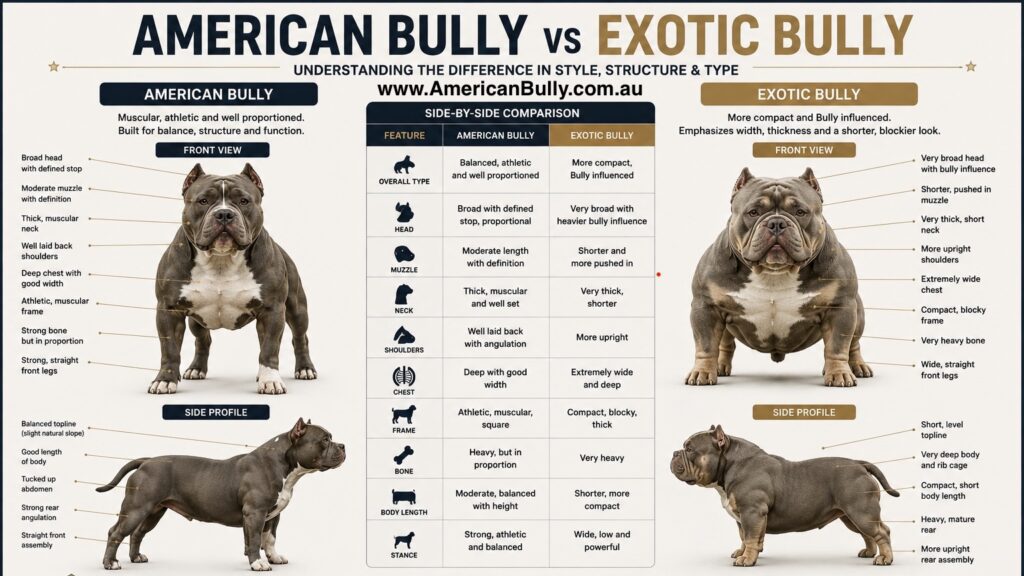
The easiest way to understand the difference is to compare the overall silhouette.
American Bully
The American Bully generally presents a powerful, muscular and substantial appearance.
Depending on the variety, the dog may be relatively compact or considerably larger.
The head is broad and blocky, the chest is substantial, the bone is heavy and the body is heavily muscled.
However, compared with the Exotic, the overall proportions are generally more moderate.
Think:
Broad + muscular + powerful + substantial.
Exotic Bully
The Exotic generally presents a lower, shorter, thicker and more exaggerated appearance.
The head is often exceptionally large relative to the body.
The chest is extremely broad, the bone is heavy, the legs appear shorter and the body is highly compact.
The facial structure also tends to show stronger Bulldog influence.
Think:
Low + compact + heavy + exaggerated + Bulldog-influenced.
Side-by-Side Comparison
| Feature | American Bully | Exotic Bully |
|---|---|---|
| Overall type | Muscular and substantial | Compact and exaggerated |
| Body | More proportioned | Shorter and thicker |
| Height | Varies by variety | Generally very compact |
| Head | Large and blocky | Extremely large and exaggerated |
| Muzzle | Short | Typically shorter and more compressed |
| Chest | Broad and deep | Extremely broad |
| Bone | Heavy | Often exceptionally heavy |
| Legs | More proportionate | Shorter-looking |
| Muscle | Highly muscular | Highly muscular and compact |
| Bulldog influence | Present within breed development | More pronounced |
| Silhouette | Powerful and balanced | Low, wide and Bulldog-like |
Why “Shorter” Doesn’t Automatically Mean Better
One of the biggest misconceptions in bully breeding is that making a dog shorter automatically makes it better.
Shorter stature can certainly be a desirable characteristic within a particular breeding program.
However, height is only one component of structure.
A good breeding program should look at the entire dog.
A shorter dog with poor structure is not necessarily an improvement over a taller dog with excellent structure.
Likewise, an extremely large head, heavy bone or massive chest is not automatically desirable if those characteristics negatively affect the dog’s ability to breathe, move or live comfortably.
The challenge is finding the right balance.
The Goal: Balancing Type, Structure and Function
For breeders working with American Bully and Exotic-influenced lines, the goal is not simply to push the dog toward greater exaggeration.
Instead, the focus can be on retaining the distinctive characteristics that define the style while maintaining proportion, structure and function.
It can instead be:
“How much type can we retain while preserving function?”
That means selecting for the characteristics that make the American Bully and Exotic styles visually distinctive while avoiding unnecessary exaggeration.
The ideal breeding program may therefore seek:
American Bully balance
Pocket compactness
Exotic head, bone and substance
Sound structure and movement
=
A More Balanced Exotic-Styled American Bully
This does not mean every breeding will produce the same result.
Genetics are not a simple formula, and puppies can inherit very different combinations of characteristics from their parents and extended bloodlines.
That is why experienced breeders evaluate the individual dog, not simply the label attached to it.
Understanding the Difference
The American Bully and Exotic Bully should not be viewed as completely unrelated dogs.
The Exotic developed from the American Bully, with selective breeding placing greater emphasis on compactness, substance and Bulldog influence.
The American Bully provides a broad foundation of bully-type characteristics, while the Exotic represents a more specialised direction toward compact and exaggerated Bulldog-influenced features.
Between the two is an interesting breeding philosophy: the Exotic-styled American Bully.
Rather than pursuing maximum exaggeration, this approach attempts to combine the visual characteristics people appreciate in the Exotic and compact Pocket styles with the proportion, structure and functionality associated with a more balanced American Bully.
Ultimately, good breeding is not simply about producing the shortest, biggest-headed or heaviest-boned dog.
It is about understanding the characteristics behind each style and making thoughtful selections that produce dogs with type, substance, structure, temperament and the ability to function as healthy companions.
The preferred height for the Exotic style is typically within the Pocket range for Standard, while Micro (Miniature) is generally under 13 inches. See our American Bully Size Comparison for a detailed size guide.
Want to understand more than just Style and Look? Learn how size, body type and style are different in our guide to American Bully Size vs Body Type vs Style.
For more breed education, structure discussions, and American Bully resources, visit:
For more breed education, structure discussions, and American Bully resources, visit: